Engineering Hub
🔙 Back to Sensors and Actuators

Vacuum Sensor Overview
Vacuum sensors are devices that measure the pressure of a fluid (liquid or gas) and convert it into an electrical signal. They are specifically designed to measure low pressures or vacuums. This signal can then be used to monitor, control, or regulate the pressure within a system. Vacuum sensors are widely used in industrial applications, automotive systems, medical devices, and consumer electronics due to their ability to provide accurate and reliable pressure measurements.
How it Works
A vacuum sensor typically consists of a diaphragm or other pressure-sensitive element that deforms under pressure. This deformation is converted into an electrical signal using various technologies such as strain gauges, capacitive sensing, or piezoelectric elements. The resulting signal is proportional to the applied pressure and can be processed by electronic circuits or microcontrollers for further use. For example, in an automotive application, a vacuum sensor can be used to monitor the vacuum pressure in the intake manifold and provide feedback to the engine control unit for optimal performance.
Key Features
- Accuracy: Vacuum sensors provide precise measurements of low pressure, which is crucial for applications that require tight control and monitoring.
- Durability: Many vacuum sensors are designed to withstand harsh environments, making them suitable for industrial and automotive applications.
- Versatility: Vacuum sensors can be used to measure a wide range of low pressures, making them adaptable to various applications.
Breakdown Table
| Name | Vacuum Sensor |
|---|---|
| Sensor/Actuator | Sensor |
| Description | A device that measures low pressure or vacuum and converts it into an electrical signal, changing the state of an electrical circuit. |
| Signal/Power Type | Electrical (Analog or Digital) |
| Common Applications | Industrial machinery, automotive systems, medical devices, consumer electronics. |
What we use in college
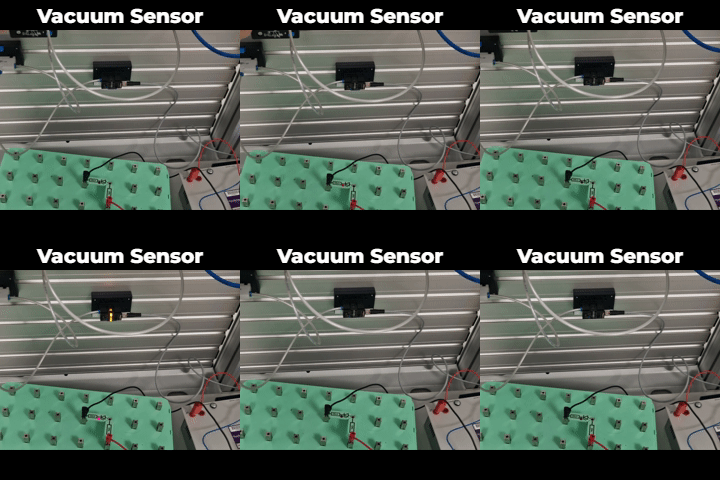
In college, we use a festo vacuum sensor (Code: SDE5-V1-O-Q4E-P-M8) in our lab setup and MPS systems. We typically use it to monitor the vacuum pressure in pneumatic systems, such as those used in our MPS (Mechatronic Production Systems) setups. The sensor has a single pneumatic tube input and 3 pins for power supply, ground, and signal output. We connect the Red Wire to our power supply, the Blue Wire to ground, and the Black wire to our output which we can then connect to a PLC or a mechantronic system to monitor the vacuum pressure and ensure that it stays within safe operating limits. This allows us to automate processes and prevent damage to equipment due to overpressure situations.
Example Video