Engineering Hub
🔙 Back to Sensors and Actuators

Capacitive Sensor Overview
Capacitive sensors are non-contact sensors that detect the presence or proximity of an object by measuring changes in capacitance. They consist of two conductive plates separated by a dielectric material. When an object comes close to the sensor, it changes the electric field between the plates, which alters the capacitance. This change can be detected and used to trigger a response in a control system. Capacitive sensors are commonly used in industrial automation, robotics, and consumer electronics for applications such as touchscreens, proximity sensing, and level detection.
How it Works
A capacitive sensor operates by creating an electric field between two conductive plates. When an object enters this field, it changes the capacitance, which is the ability of the system to store an electric charge. The sensor detects this change and can determine the presence or proximity of the object. For example, in a touchscreen, when a finger touches the screen, it alters the capacitance at that point, allowing the device to register the touch and respond accordingly.
Key Features
- Non-Contact Detection: Capacitive sensors can detect objects without physical contact, making them ideal for applications where hygiene or wear and tear is a concern.
- High Sensitivity: They can detect small changes in capacitance, allowing for precise detection of objects at varying distances.
- Versatility: Capacitive sensors can be used to detect a wide range of materials, including metals, plastics, and liquids.
Breakdown Table
| Name | Capacitive Sensor |
|---|---|
| Sensor/Actuator | Sensor |
| Description | A device that detects the presence or proximity of an object by measuring changes in capacitance, changing the state of an electrical circuit. |
| Signal/Power Type | Electrical (ON/OFF) |
| Common Applications | Industrial machinery, robotics, consumer electronics, touchscreens, proximity sensing. |
What we use in college
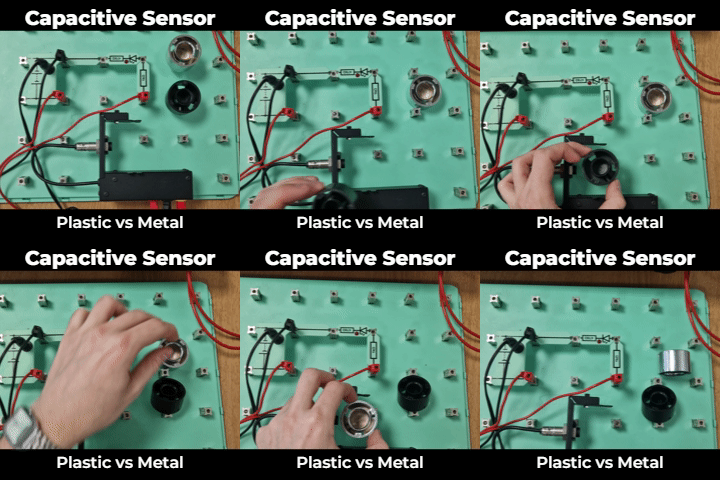
In college, we use a festo inductive capacitance sensor (Code: SIEN-M8NB-PS-S-L) mainly in our MPS systems. We typically use them for the detection of metal objects, such as the presence of a metal part on a conveyor belt. The sensor is mounted in a fixed position and detects when a metal object comes within its sensing range, allowing us to automate processes such as sorting or quality control. The sensor is connected to a PLC, which processes the signal and can trigger actions such as stopping a machine or activating an alarm when a metal object is detected.
Example Video