Engineering Hub
Intro:
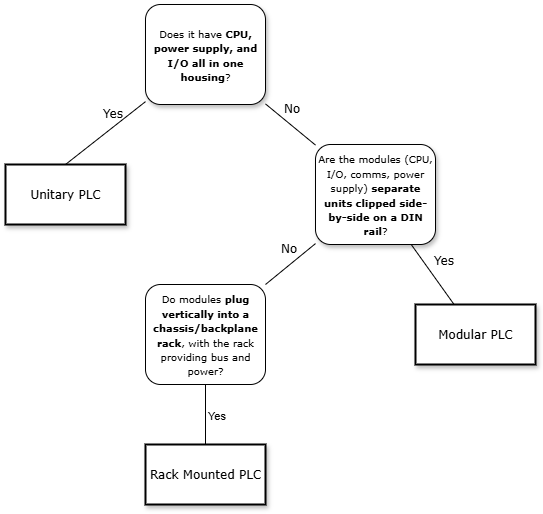
A Programmable Logic Controller (PLC) is an industrial digital computer designed for the control and automation of manufacturing processes, machinery, and other equipment. PLCs are used in various industries to monitor inputs, make decisions based on programmed logic, and control outputs to automate processes. There are several types of PLCs, each with its own characteristics and applications. The main types include unitary PLCs, which are compact and all-in-one devices suitable for small applications; modular PLCs, which consist of separate modules that can be customized and expanded for larger systems; and rack-mounted PLCs, which are designed for high-performance applications and can accommodate multiple modules in a rack system. This page explores the different types of PLCs, their features, advantages, and typical use cases in industrial automation.
Identification Tree
Audio:
Presentation:
Other Materials:
- YouTube: Programable Logic Controller Basics Explained - automation engineering
- W.Bolton: Programmable Logic Controllers, 5th Edition (Chapter 1) (Page 12)